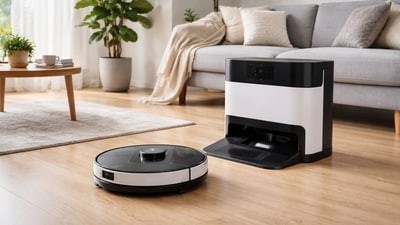
Robot vacuums have become a popular household tool, revolutionizing the way we clean our homes. Despite their growing popularity, many people still misunderstand the true capabilities of these smart devices. Having tested and reviewed robot vacuums extensively, it’s clear that there are several myths surrounding them. Some people underestimate their potential, while others expect them to do it all. Let’s take a look at 8 common robot vacuum myths and what these devices can really do.
1. Robot Vacuums Only Vacuum
One of the biggest misconceptions about robot vacuums is that they only suck up dust and debris. While this was true for early models, most modern robot vacuums now come equipped with mopping capabilities. Many mid-range models include a water tank and mop pads, allowing you to mop your floors while vacuuming. Premium models take this further, offering features such as “no-mop zones,” automatic mop lifting for carpets, and even self-cleaning docks that refill the water and clean the mop pads. So, robot vacuums are much more than just vacuums—they’re multifunctional cleaning devices.
2. They Can’t Clean Multiple Floors
Another myth is that robot vacuums can’t clean multiple floors of a home. While it’s true that they can’t climb stairs on their own, most models now come with the ability to store multiple floor maps. This means that you can carry the robot vacuum between floors and have it navigate each floor independently. Sensors ensure that the vacuum won’t fall down stairs, and while it won’t automatically return to its dock on a different floor, it can still effectively clean multiple floors with a little help from you.
3. Roomba is Still the Best Choice
Roomba, a popular name in the world of robot vacuums, is no longer the uncontested leader. While Roomba continues to be a reliable option, other brands like Dreame, Ecovacs, Eureka Forbes, and Eufy have emerged with advanced features and better overall performance. These newer models often provide better value for money and offer features that make them strong competitors to Roomba. So, while Roomba remains a solid choice, it’s no longer the only option to consider.
4. They Can’t Handle Pet Hair
Pet owners often worry that robot vacuums can’t handle the challenge of pet hair. While it can be tricky, many robot vacuums are designed to tackle pet fur. Regular cleaning with a robot vacuum can help prevent fur buildup, making it easier to deep clean later. Look for models with strong suction power (around 6,000Pa or higher) and self-emptying bins to deal with pet hair efficiently. High-end docking stations also prevent jams caused by fur, making these vacuums ideal for pet owners.
5. Robot Vacuums Are Too Complicated
Some believe that robot vacuums are too technical to use. However, many models are designed with user-friendly features. The setup process is often straightforward, and most models come with an app that guides you through mapping your home. Once this is done, all you need to do is press “Go,” and the vacuum will take care of the rest. Even though robot vacuums have advanced features, their basic operation is simple and convenient for everyday users.
6. Clutter Will Stop Them
It’s a common belief that robot vacuums can’t handle clutter or obstacles. In reality, modern robot vacuums use smart navigation to avoid obstacles. Top models can even recognize different types of clutter. While a little mess won’t usually cause problems, items like cables or non-house-trained pets can still be an issue. Some basic preparation, like clearing wires or ensuring pets are not in the way, is still necessary for optimal performance.
7. They Replace Manual Vacuums
Robot vacuums are great for regular, light cleaning, but they aren’t a full replacement for traditional vacuums. While they can handle everyday dust and dirt, areas like stairs, tight corners, and sofas still require manual cleaning. Robot vacuums typically don’t offer the same suction power as handheld models, so for deep cleaning sessions, you’ll still need to use a traditional vacuum. Consider robot vacuums as a supplement, not a substitute, for manual cleaning.
8. They’re Too Expensive
Many people assume that robot vacuums are luxury products, but that’s no longer the case. While high-end models with features like self-emptying docks and automatic mop cleaning can cost over ₹50,000, there are plenty of affordable options available between ₹15,000 to ₹30,000. These models still offer excellent daily cleaning performance, and you can often find great deals during sales events like the Amazon Great Indian Festival or Flipkart Big Billion Days. So, you don’t have to break the bank to experience the convenience of a robot vacuum.
Conclusion
Robot vacuums are far more versatile and effective than many people realize. They can handle a variety of tasks beyond simple vacuuming, including mopping, multi-floor cleaning, and pet hair management. With a range of options at different price points, robot vacuums are no longer a luxury product but an accessible, time-saving tool for any home. By debunking these myths, it’s easier to appreciate just how much a robot vacuum can truly do for your home.




One Comment