


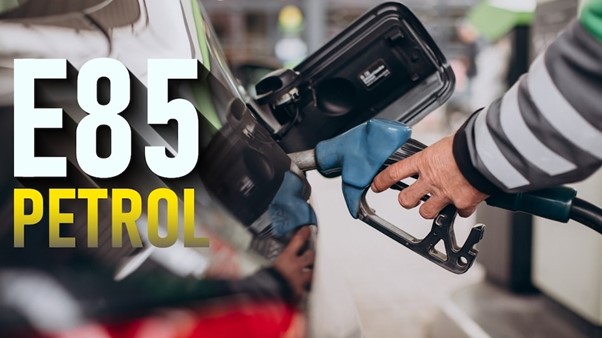
India is preparing for a major shift in its fuel strategy. After promoting E20 petrol, the government is now working on introducing E85 fuel—a blend containing up to 85% ethanol. This move is aimed at reducing crude oil dependency, lowering emissions, and boosting domestic energy production.
Government Likely to Release Draft Soon
According to recent reports, the Indian government may soon release draft guidelines for E85 fuel. Officials indicate that there is internal consensus, and initial groundwork at the market level has already begun.
E85 is expected to be introduced as a separate fuel grade, different from existing blends like E20. While E20 contains up to 20% ethanol (sometimes slightly higher), E85 will significantly increase the ethanol share to 85%.
Why India Is Pushing for E85 Fuel
India currently imports nearly 90% of its crude oil needs, making it vulnerable to global price fluctuations and geopolitical tensions—especially in regions like the Strait of Hormuz.
To reduce this dependency, the government has been steadily increasing ethanol blending in petrol. Narendra Modi previously highlighted that ethanol blending has already helped cut millions of barrels of oil imports annually.
By moving to E85, India aims to:
- Reduce crude oil imports
- Promote cleaner fuel alternatives
- Support local agriculture
What Makes Ethanol Important?
Ethanol is a renewable fuel produced from crops like sugarcane, corn, and grains. Compared to petrol, it burns cleaner and produces fewer emissions.
Nitin Gadkari has strongly advocated ethanol-based fuels and has even showcased vehicles running on 100% ethanol. He continues to push automakers to develop vehicles compatible with higher ethanol blends.
Not All Vehicles Can Use E85
One of the biggest challenges is compatibility. E85 fuel cannot be used in regular petrol vehicles. It requires special engines known as flex-fuel vehicles (FFVs).
Using E85 in a standard engine can:
- Damage engine components
- Reduce performance
- Cause starting issues
Automakers will need to manufacture more FFVs before E85 can be widely adopted.
Infrastructure Challenges
Introducing E85 fuel also requires major changes at fuel stations. Oil companies will need to:
- Install separate storage systems
- Use dedicated fuel nozzles
- Maintain clear labeling to avoid confusion
Since E20 and E85 will coexist initially, proper infrastructure and consumer awareness will be critical.
Long-Term Planning Already Underway
India’s ethanol blending program has been in progress for over a decade. Key milestones include:
- Policy roadmap discussions by NITI Aayog in 2021
- Early notifications for E85 and E100 fuels issued in 2016
- Testing norms for vehicles using E5 to E85 fuels introduced in 2022
This shows that E85 is not a sudden move but part of a long-term energy strategy.
Benefits and Challenges of E85 Fuel
Benefits:
- Lower dependence on imported oil
- Reduced air pollution
- Increased demand for agricultural products, benefiting farmers
Challenges:
- Slightly lower fuel efficiency compared to petrol
- Need for new vehicle technology
- High investment in fuel infrastructure
- Consumer awareness and adoption
Conclusion
The introduction of E85 fuel could transform India’s energy and automotive sectors. While the benefits are significant, successful implementation will depend on coordinated efforts between the government, automakers, fuel companies, and consumers.
If executed well, E85 could be a major step toward energy independence and a cleaner future for India.