


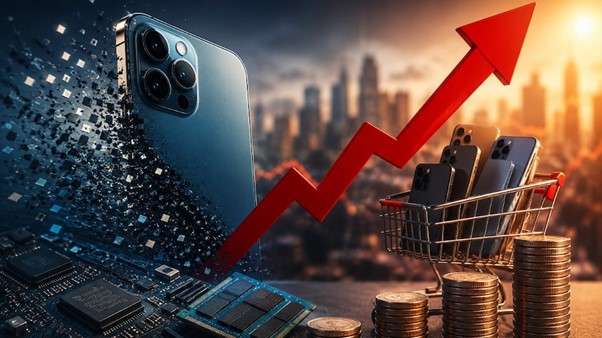
Smartphone Prices Rising Rapidly in India
Buying a new smartphone in India is becoming more expensive than ever. Since the beginning of 2026, prices of several popular smartphones have increased significantly, with some devices becoming up to 40% costlier. Industry experts believe this is only the beginning, and prices may continue to rise in the coming months.
Major smartphone brands such as OnePlus, Nothing, Redmi, Realme, and Motorola have already increased prices across multiple models. In some cases, phones are now ₹2,000 to ₹6,000 more expensive than their original launch prices.
The sharp rise is affecting not only flagship smartphones but also mid-range and budget devices, which are the most popular categories in India.
Why Are Smartphone Prices Increasing?
The biggest reason behind the price hike is a global shortage of memory chips, especially DRAM and NAND storage chips. These components are essential for smartphones, laptops, gaming consoles, and servers.
The tech industry has even started using the term “RAMageddon” to describe the ongoing memory crisis.
However, the shortage is not being caused only by smartphone demand. Artificial Intelligence (AI) companies are now competing for the same chips.
AI Industry Creating Pressure on Chip Supply
Companies like OpenAI, Google, Microsoft, and Meta are building massive AI data centers worldwide. These AI systems require high-performance memory chips in huge quantities.
As a result, chip manufacturers are prioritizing AI-related production over smartphone components. This shift has reduced the supply available for mobile brands and increased manufacturing costs.
Nothing CEO Carl Pei recently stated that rising DRAM and NAND prices are forcing smartphone companies to pass the extra cost on to customers.
Reports suggest that prices of some memory chips have increased several times compared to last year.
Popular Smartphones Become More Expensive
The impact is already visible in the Indian smartphone market.
For example, the OnePlus 15, which launched at around ₹72,999, is now reportedly selling for nearly ₹77,999. Similarly, the OnePlus 15R has also seen a major price jump.
Nothing Phone 4a Pro prices have reportedly increased from approximately ₹39,999 to ₹44,999. Redmi and Realme smartphones have also become costlier by ₹2,000 to ₹5,000 depending on the model.
Retailers say that new stock arriving from companies is being supplied at higher prices, which is directly affecting consumers.
Budget and Mid-Range Phones Also Affected
Earlier, Indian consumers enjoyed aggressive pricing in the ₹15,000 to ₹30,000 segment. Brands offered more RAM, better cameras, larger batteries, and even 5G support at affordable prices.
Between 2016 and 2023, smartphones continuously became more powerful while remaining budget-friendly. Features like 8GB RAM and 5G connectivity became common even in lower-priced phones.
Now, that trend appears to be slowing down.
According to Counterpoint Research, the average selling price of smartphones may rise further in 2026 as brands continue adjusting prices across all categories.
Could Smartphones Become 50% More Expensive?
Experts warn that if the chip shortage continues, smartphone prices could rise another 20% to 40% over the next one to two years.
Devices with higher RAM and storage capacities are expected to be affected the most because memory components are now among the costliest parts of a smartphone.
Samsung mobile chief TM Roh has also acknowledged that AI infrastructure demand is increasing the cost of smartphone components globally.
Indian Consumers May Delay Upgrades
The rising prices are already changing consumer behavior in India. Many users are now keeping their phones for longer periods instead of upgrading every year.
The refurbished smartphone market is also expected to grow rapidly as buyers search for affordable alternatives.
Industry analysts believe smartphone brands may gradually shift their focus toward premium devices because maintaining profit margins in budget phones is becoming difficult.
Conclusion
The ongoing AI-driven chip shortage is reshaping the global smartphone industry. What started as a supply issue has now become a major pricing challenge for both companies and consumers.
Unless memory chip supply improves soon, Indian buyers may continue facing higher smartphone prices throughout 2026 and beyond.