Introduction: Tesla’s Slow Start in India
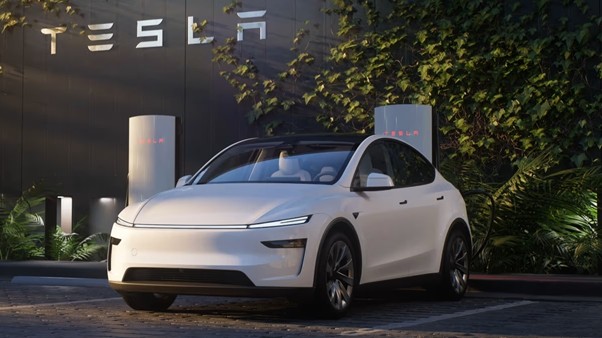
Tesla entered India with much fanfare in July last year, launching its first car, the Model Y, at a premium price of ₹59.89 lakh (ex-showroom, Mumbai). Despite Tesla’s global reputation and cutting-edge technology, the company has struggled to attract buyers in the Indian market.
In the first seven months, from September 2025 to March 2026, Tesla sold just 342 cars, averaging about 43 units per month, according to the latest data from the Federation of Automobile Dealers Associations.
India’s EV Market Growing Rapidly
While Tesla struggles, India’s overall electric vehicle (EV) market is booming. In FY 2026, the country recorded around 24.52 lakh EV sales across two-wheelers, three-wheelers, passenger vehicles, and commercial vehicles, reflecting a 24.6% year-on-year growth.
Specifically, electric passenger vehicles grew 83.63%, reaching 1,99,923 units, close to 2 lakh cars. Compared to this, Tesla’s sales of 342 units show the company is barely making a dent in India’s fast-growing EV market.
Challenges Tesla Faces in India
1. High Pricing
The Model Y in India costs approximately ₹60–70 lakh, which is 70% more expensive than in the U.S. due to import duties ranging from 70–100%. In a price-sensitive market like India, this positions Tesla only for a small luxury buyer segment, which forms less than 1% of the market.
2. Imported Cars Only
Tesla currently imports all cars from its Shanghai Gigafactory in China, increasing costs due to the complete built-up unit (CBU) route. Unlike competitors producing locally, Tesla misses out on “Make in India” advantages, keeping prices high.
3. Limited Model Portfolio
Tesla India only offers the Model Y, which hasn’t seen major updates since launch. In contrast, competitors like BYD, VinFast, Mercedes-Benz, BMW, Volvo, Hyundai, Tata Motors, and Mahindra offer a wide range of EVs across price points and features. Many of these vehicles are cheaper or more feature-loaded than the Tesla Model Y.
4. Feature Limitations
Globally, Tesla promotes its Full Self-Driving (FSD) feature, but in India, government regulations do not allow FSD usage. Tesla charges ₹6 lakh for this feature in India, which adds to the cost. Additionally, the Model Y’s ground clearance of 167mm (6.58 inches) is low for Indian roads, limiting its practicality.
Tesla’s Efforts to Expand in India
Despite slow sales, Tesla is expanding its presence. Currently, Tesla has showrooms and service centers in Delhi, Mumbai, Gurugram, and Bengaluru. The company recently launched its first in-mall Supercharger station at Nexus Mall, Navi Mumbai, bringing the total Supercharger count in India to five.
Tesla claims the Supercharger can provide 275 km of range in just 15 minutes of charging for the Model Y, aiming to improve usability and attract potential buyers.
Conclusion: A Niche Product in a Growing Market
Tesla’s global brand value and advanced technology are undeniable. However, in India, high pricing, limited models, import duties, and feature restrictions have made it a niche luxury product rather than a mainstream EV.
With India’s EV market growing rapidly, Tesla will need localized production, competitive pricing, and feature adaptation to capture a meaningful share of this high-growth market. Until then, the company’s Indian journey remains slow despite global success.