


Rising AC Demand Brings Safety Concerns Into Focus
Air conditioners are no longer considered a luxury in India. With record-breaking summer temperatures and rising humidity levels, ACs have become a necessity in many homes. However, recent incidents of AC fires and cooling failures have raised serious questions about air conditioner safety.
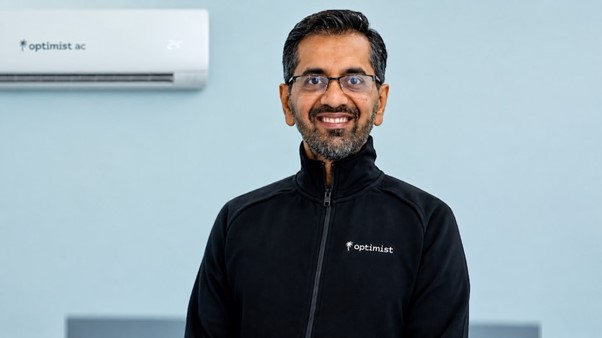
In a recent interaction, Optimist founder and CEO Ashish Goyal shared important insights about AC safety, gas leaks, humidity control, and how smart technology can improve the cooling experience for Indian consumers.
Optimist is a homegrown Indian AC brand that has recently attracted major investments and is focusing on products designed specifically for Indian weather conditions.
AC Is Not Just About Cooling
According to Ashish Goyal, most people believe an AC only lowers room temperature, but that is only part of its job.
He explained that humidity is one of the biggest problems in India. Even when temperatures are around 35–38 degrees Celsius, high moisture levels in the air can make people feel uncomfortable.
An air conditioner also removes humidity from the air. When warm air passes through the cold internal surface of the AC, moisture turns into water, helping the room feel cooler and more comfortable.
However, if humidity control is not managed properly, users may experience discomfort.
Why People Feel Dryness and Headaches in AC Rooms
Goyal said many ACs sold in India are originally designed for foreign climates, where weather conditions are very different.
As a result, Indian users often complain about dry skin, throat irritation, headaches, or discomfort after sitting in air-conditioned rooms for long periods.
He clarified that these issues are not always caused by ACs themselves, but by incorrect temperature settings and designs that are not optimized for Indian conditions.
He also dismissed the common myth that ACs weaken bones. According to him, problems occur when users suddenly expose themselves to extremely low temperatures, making it difficult for the body to adjust.
Optimist AC Designed for Indian Weather
Optimist claims its ACs are specially built for Indian summers and have been tested in temperatures up to 50 degrees Celsius.
The company believes consumers should understand how to choose the right AC instead of focusing only on brand names and pricing.
Goyal pointed out that many users purchase ACs without understanding cooling capacity, humidity management, or long-term maintenance needs. This often leads to reduced cooling performance, gas leaks, and frequent servicing after a few years.
What Really Causes AC Gas Leaks?
One of the biggest misconceptions, according to Goyal, is that gas leaks are common and unavoidable.
He explained that properly designed and correctly installed air conditioners should not face regular gas leakage problems.
The issue usually develops in areas where copper pipes bend or where corrosion occurs over time. Poor installation and weak design can increase the chances of leakage.
Smart Sensors Can Detect Gas Problems Early
Optimist has introduced smart sensors that can monitor the AC’s internal performance.
The system can reportedly alert users if the gas level is dropping or if the machine is not functioning properly. This feature is useful because many users only discover gas-related issues after cooling performance becomes weak.
The company says this technology can help customers avoid unnecessary servicing and repeated gas refilling.
Software Updates for Air Conditioners
Another major feature highlighted by the company is software-based improvements.
Similar to smartphones, Optimist ACs can receive software updates that improve performance and add new features over time.
Goyal shared an example where a feature issue was fixed remotely through an overnight software update. He believes future air conditioners will rely heavily on software alongside hardware.
Focus on Fast Cooling and Lower Electricity Usage
The company has also introduced a fast-cooling mode that temporarily increases power to cool rooms quickly, especially useful during extreme heat.
Energy efficiency remains another key focus area. Goyal said that star ratings alone do not show real-world electricity consumption. Instead, AC systems should be designed to provide better cooling while consuming less power.
Users can also monitor electricity consumption through the connected mobile app.
Conclusion
As India’s AC market continues to grow rapidly, safety, smart monitoring, and climate-specific design are becoming increasingly important.
Experts believe consumers now need to pay closer attention to installation quality, humidity control, energy efficiency, and smart features rather than only comparing prices.
With technology-driven innovations and smarter systems, the future of air conditioners in India may soon become safer, more efficient, and better suited for Indian weather conditions.