Introduction
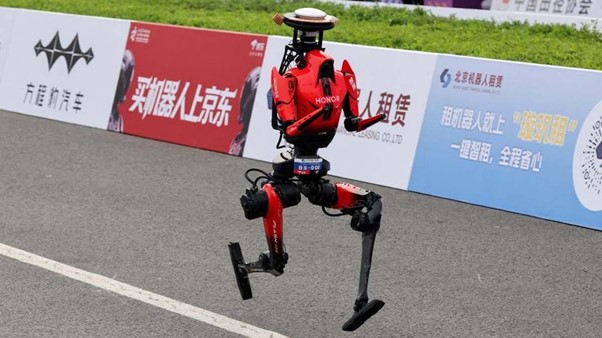
In a remarkable display of robotics and artificial intelligence, the Chinese humanoid robot Lightning, developed by Honor, completed a 21-kilometer half marathon in just 50 minutes and 26 seconds in Beijing. This performance shattered the human world record of 57 minutes and 20 seconds, set by Ugandan runner Jacob Kiplimo, beating it by nearly seven minutes.
Lightning’s Record-Breaking Run
The event took place on Sunday in Beijing, where Lightning, a bright red humanoid robot standing 169 centimeters tall, ran the entire half marathon without slowing down. Its performance was made possible by a combination of autonomous navigation systems and powerful burst power motors, allowing it to maintain speed and balance throughout the race.
During the race, Lightning moved its small arms to stabilize itself, demonstrating a high level of human-like coordination and endurance. Race organizers confirmed that the robot ran continuously, crossing the finish line without fatigue.
Progress Compared to Last Year
Just a year ago, Lightning and other robots were trailing behind human participants in similar races. This year, however, Lightning not only outpaced all human runners but also left other competing robots far behind. The previous year’s champion robot finished almost two hours later than Lightning.
This year’s half marathon featured over 100 teams, which is five times more participation than last year, indicating the growing popularity of robotic sports in China.
China’s Leadership in Robotics
China has been investing heavily in robotics since 2015 as part of a national strategy to move away from being known primarily as a low-cost labor country. Robotics was included in 10 key development sectors, with goals to strengthen production and supply chains by 2025.
China has also hosted the first Humanoid Robot Games, showcasing competitions in football, boxing, and martial arts. More recently, robots performing martial arts at China’s New Year gala wowed audiences with their agility and coordination. Lightning’s half marathon achievement highlights China’s rapid advancements in humanoid robotics and AI.
Technological Implications
Lightning’s success demonstrates the speed at which robotics and artificial intelligence are advancing. The robot’s endurance, balance, and autonomous decision-making abilities indicate a significant leap in humanoid robotics technology.
While the United States still holds some of the most advanced humanoid robot models, China is rapidly catching up, especially in sports and performance-based robotics. Lightning’s victory illustrates the country’s growing capabilities in AI-powered automation and robotics innovation.
The Global Significance
This achievement not only sets a new standard for robotic endurance but also signals a potential shift in how AI and robotics might compete alongside humans in physical activities. It also underscores the intensifying technology race between China and the U.S., particularly in the fields of robotics and AI research.
Conclusion
Honor’s Lightning has set a historic milestone by completing a half marathon faster than any human runner in the world. With a time of 50 minutes and 26 seconds, the robot showcases China’s rapid advancements in humanoid robotics, AI, and autonomous systems. As robotics technology continues to evolve, events like this will increasingly blur the line between human and machine performance, highlighting the exciting future of AI-driven athletics.